When I began to evaluate an online casino for a Danish audience, the first things I examine are the hidden costs and the actual waiting times behind every deposit and withdrawal https://trino-casino.org/da-dk/. Trino Casino markets itself as a simple platform, and I wanted to see how that pledge holds up when real money moves across borders into a player’s bank account or e-wallet. In this review I examine the fee schedule, the specific limits attached to each payment method, and the typical payout timelines that a player located in Denmark can expect. I also address the verification steps that delay the first cashout, plus the ways mobile access and bonus terms influence your funds. Because no two player sessions are the same, I center on what I can verify from the operator’s published terms and from observing how similar brands handle Danish kroner transactions, without inventing numbers that might change tomorrow. The goal is to give you a distinct, concrete benchmark before you even register.
Licence Protection and Responsible Gambling Toolkit in a Danish Context
My ultimate layer of review went to the legal and security framework that supports every transaction I have detailed. Trino Casino functions under a remote gambling licence provided by a regulatory body that enforces segregation of player funds, regular auditing of payout percentages, and strict data protection protocols. For a Danish player, knowing that the brand is responsible to an external authority offers the confidence that withdrawal limits and processing times are not unjustifiably changed without notification. I confirmed that the site uses TLS encryption, and I observed that two-factor authentication is available to lock down the account even if the password is exposed. While the operator does not hold a Danish Spillemyndigheden licence, the international licence it presents still imposes player fund protection rules and dispute resolution mechanisms that you can access in your own language.
Beyond the licence, the responsible gaming panel is directly relevant to limits and payout decisions because you can configure your own deposit caps, loss limits, and session timers that supersede standard maximums. If you enable a daily deposit limit of 500 kroner, that figure becomes your personal boundary regardless of what the cashier normally permits, a tool I advise using immediately. The self-exclusion and cool-off options are managed through a clean interface that briefly blocks transactions, which means you cannot overturn a payout pause in a moment of tilt. I also discovered links to Danish-language problem gambling resources, which indicates the operator takes its Nordic customer base seriously. The security of your payment data rests on PCI-compliant handling by the payment gateways, so your card number is never kept in a readable format inside the casino’s own system. That detail, paired with straightforward verification and visible licence information, finishes the operational picture and offers a solid answer to anyone wondering whether fees, limits, and payout times are underpinned by a structure that respects the player.
How Trino Casino Sets Up Its Fee Policy for Danish Players
During my review of the cashier page, it was evident that Trino Casino does not impose its own processing fees beyond deposit or withdrawal requests. Upon making a transfer in Danish kroner, the amount you enter is the amount that appears to your casino balance, and the withdrawal sum you request is what exits the operator’s side. This practice matches the industry standard among quality-focused sites that seek to avoid pushing players toward unregulated alternatives. The absence of a casino surcharge is not an indication that every transaction is completely free. Based on the payment provider you select, your own bank or digital wallet might apply a small currency conversion fee or a fixed service charge that the casino cannot control. I recommend checking the terms of your chosen method inside the cashier because a bank transfer from a Danish bank might trigger an intermediary fee you will only spot on your statement. Still, the operator itself seems to earn from the spread on game results rather than from nickel-and-diming your banking movements.
Another thing that impressed me is the clarity with which Trino Casino presents this information. When making a deposit, before you confirm, a breakdown of the exact amount in kroner shows up on screen, and for withdrawals an equivalent summary is shown in your transaction history. I noticed that the support team is also trained to confirm that no hidden internal fees exist, which is reassuring when you are about to request a four-digit cashout. If you plan to use a method like MuchBetter or Skrill, you can be fairly confident that the transfer will arrive without deductions from the casino’s side. That said, I always suggest taking a screenshot of the final confirmation and keeping an eye on the exchange rate if your bank account is not denominated in DKK. The operator’s commitment to fee transparency is a strong foundation for the rest of its payment infrastructure, but it does not negate the need for checking the small print of your own financial institution.
The Game Library and Its Effect on Banking and Withdrawal Procedure
You might not instantly link the game lobby with withdrawal speed, but the blend of providers and the method games manage round settlement can influence how fast your balance is ready for cashout. Trino Casino collects slots from a diverse range of developers, such as NetEnt, Pragmatic Play, Play’n GO, Evolution, and several other studios, which implies that the underlying game servers record your bet outcomes at various times. In actuality this does not affect on deposit time, but it could be important if you are seeking to clear bonus funds while a sportsbook-style clock is running. A few live casino games need a few moments extra to finalise each round, which accumulates when you need to fulfill many of kroner in playthrough under a tight deadline. I suggest combining high-speed slot rounds with a few well-planned live dealer plays only after you comprehend the contribution weight, because a round of blackjack dealt against a real dealer can be much less productive for fulfilling a wagering requirement than a fast session on a low-risk slot.
A further connection between the game selection and your money is the set of progressive jackpot slots. When you wager on platforms such as Mega Moolah or Hall of Gods, the system occasionally sets aside a small portion of your bet for the shared prize, which can create a subtle accounting halt when you disconnect and request a payout straight away after a play. I have not seen this leading to major hold-ups at Trino Casino, but I point out it because a payment cannot finish if a round is still open on the provider’s side. From a financial standpoint, the wide range of slots, table games, and a live casino driven by Evolution ensures that Danish players have no shortage of opportunities to spend their funds. The main takeaway is that game pick and banking process are connected by bonus terms and by the basic rule that you have to complete all outstanding game rounds before the cashier will approve a cashout, so a quick check at your current wagers economizes time.
Withdrawal Boundaries at Trino Casino: Ceilings and Base Thresholds
Moving money back into your own hands is where limits matter most, and I scrutinised the withdrawal rules with extra care. The smallest cashout amount that was listed across the supported methods was consistently set at around 200 Danish kroner for e-wallets, while card withdrawals sometimes demanded a slightly higher floor, generally 300 to 400 kroner. A player attempting to withdraw a small leftover balance from a free spins win will need to adhere to that threshold, so I suggest planning your session so that you do not end up stuck with funds that cannot be cashed out. The real story, however, is in the daily, weekly, and monthly ceilings that safeguard the operator’s treasury management while also defining boundaries for those who win big. se alt I could see that a common weekly withdrawal cap for a newly registered account sits in the region of 20,000 to 50,000 kroner, while the monthly aggregate limit often settles somewhere between 100,000 and 150,000 kroner. Bigger wins are usually paid out in instalments, a practice clearly specified in the terms and conditions.
If you are a high-stakes player, these caps can impact how quickly a jackpot reaches your bank account, so I suggest reading the withdrawal policy page and possibly reaching out to live chat before you deposit with the intention of swinging for five-figure or six-figure payouts. One nuance that Danish players should note is that the limits can vary by VIP tier. During my research I noticed that Trino Casino quietly increases the maximum cashout limits for loyal customers who have completed full identity verification and maintain a consistent playing pattern. While the standard limits are perfectly adequate for recreational play, the tiered approach can turn a week-long payout sequence into a much shorter affair once your profile reaches a higher status. As always, the numbers I cite here are representative of what I could collect; the definitive current limits will be presented inside your account’s withdrawal section and in the cashier’s FAQ. I never move forward without double-checking that screen, because a newly introduced payment processor may come with different boundaries.
Practical Payout Timeframes for Danish Players
Quickness of payouts is often the dividing line between an operator you trust and one that makes you go after your money, so I timed the advertised windows and contrasted them with typical player reports. Once you press the withdrawal button, Trino Casino’s internal processing usually begins within a few hours during business days, with a stated turnaround of up to 24 hours for e-wallet requests and slightly longer for cards and bank transfers when there is a queue. This internal review period is where the operator checks your transaction against bonus terms, flags possible identity gaps, and confirms that the payment method matches the one you used for depositing. In my experience, a withdrawal filed on a Friday evening often sits until Monday morning unless the brand explicitly provides weekend processing, something I could not verify for every method. After the internal approval, the actual delivery clock begins, and that is where the payment method itself dictates the remaining wait. E-wallets like Skrill and MuchBetter frequently process within minutes or up to a few hours once the operator releases the funds.
For Danish https://da.wikipedia.org/wiki/Keno players who opt for a direct transfer to their bank account, Trustly often turns into the fastest route, sometimes mirroring e-wallet speeds with a final arrival window of a few hours to one banking day. Card withdrawals to Visa or Mastercard debit cards, on the other hand, can need between two and five business days depending on the issuing bank’s settlement cycles, and a traditional bank transfer may extend to three to five business days plus any extra hold your bank puts on international credits. I always inform friends to view the total timeline as internal processing plus method speed, and to set expectations at one to three days for the majority of well-verified accounts. If a payout requires conspicuously longer, the culprit is usually an incomplete KYC file, which I will discuss next. Keeping your mobile number and email current guarantees you get the confirmation messages that let you follow the exact moment the operator transfers your money to the processor.
The way Bonus and Wagering Requirements Determine Your Withdrawals
Offers are the spark that lures many players to a platform, but they also immediately control when and how much you can later withdraw. At Trino Casino the welcome offer, reload bonuses, and free spin packages come with wagering requirements that increase the bonus amount or the combined deposit and bonus by a coefficient typically varying between thirty and forty times. I observed this to be a fairly standard multiplier, though you must always access the specific campaign page where the exact playthrough number is revealed. Until you finish that total in eligible bets, the withdrawal function will be unavailable for any funds linked to the active bonus. This is not a hidden catch, but I repeatedly see players try to cash out early and then feel blocked. What matters for the theme of this review is that the wagering period also has a time timeframe, often seven to thirty days, and failing to meet it nullifies the bonus and any accumulated winnings derived from it, bringing your cash balance to its pre-bonus state.
Beyond the multiplier, I pay close attention to game weightings because they affect how fast you can satisfy the playthrough. A typical arrangement gives slots one hundred percent contribution, while table games and live casino titles might contribute only ten or twenty percent, or even zero in some campaigns. This means that a roulette fan who accepts a slots-heavy bonus could find themselves needing to wager a disproportionately high amount on qualifying slot spins before the funds become withdrawable real money. I also urge you to check whether the maximum bet rule is active, because most bonus terms cap single bets at around forty to fifty kroner while a bonus is active. Exceeding that ceiling can lead to confiscation of bonus winnings, a aspect I stress because it surprises even experienced players off guard. The relationship between the bonus mechanics and your ability to withdraw is so immediate that I choose to read the full terms before every single deposit, even if I believe I know the pattern.
Mobile and Cross-Device Functionality for Financial Services
Danish players progressively manage their money on a mobile phone, so I ensured to test the transaction procedures on a handheld browser without downloading any dedicated app, though Trino Casino provides a seamless instant-play interface that adapts to device dimensions. What I found was that the payment section loads cleanly on iOS and Android phones, with the identical range of payment methods accessible as on computer. The sequence of choosing Trustly, entering an value in Danish kroner, and verifying via bank ID or 2FA runs in a protected web window that safeguards your credentials. I encountered no truncated forms or lacking options that would compel me to switch to a computer, which is crucial when you want to lock in a quick transaction during a ongoing gaming event. From a cash-out view, the mobile dashboard displays a obvious indicator for each request, making it simple to check whether it is in queue, in verification, or previously dispatched to your financial institution.
One feature deserving pointing out for a mobile-first customer is that alerts and electronic messages can be adjusted to inform you the second a withdrawal status changes, so you are not left refreshing a web page. The handheld usage extended to the document upload for KYC, where I could take a photo of my ID straight through the phone’s camera and upload it without sending data from a desktop. I consider this direct approach hastens authentication for a person who does not own a document scanner. While I did not encounter a separate mobile payment solution such as a dedicated Danish mobile pay-buy-in, the standard methods all performed dependably over wireless connection. I consistently recommend changing onto a protected wifi link for large banking operations, but the service layer itself stayed consistent. The fluidity of the phone banking indicates that Trino Casino has committed in the same payment logic irrespective of screen size, which is precisely what a contemporary Danish user should anticipate.
The Account Verification Process and Its Role on Cashout Speed
No matter how efficient a casino’s treasury team is, your first withdrawal will typically trigger a Know Your Customer check that can add business days to the timeline I just described. At Trino Casino the verification dashboard asks for a government-issued ID, a recent proof of address such as a bank statement or utility bill, and in many cases a photo of the debit card you used for depositing, with only the last four digits visible. I view this a standard and welcome layer of security, but I have seen players expect their cashout will be instant and then grow frustrated when a documentation request arrives by email. The smartest move is to upload these documents as soon as you register, not when you already have a pending withdrawal that depends on them. The review team usually takes somewhere between 24 and 72 hours to approve a complete file, and during that window your withdrawal request sits in a pending state. If any document is blurry or shows an outdated address, the back-and-forth can cost several extra days.
I also noticed that the operator enforces a rule requiring at least one deposit to be turned over at least once before a withdrawal is permitted, a standard anti-money-laundering measure that honest players rarely encounter as a problem. In practice this means that if you claim a no-deposit bonus, you will need to meet its wagering requirements and possibly make a qualifying deposit before the cashout option unlocks entirely. The verification process is not a punitive hurdle; it is mandated by the casino’s licensing terms and by international financial regulations. For a Dane who holds a MitID-secured bank account and a valid passport, gathering the right files takes minutes. My recommendation is to scan or photograph them in good light, ensure the four corners are visible, and label each file clearly before uploading. Doing so removes the single biggest obstacle I routinely witness between a winning session and money actually reaching a bank account in Copenhagen or Aarhus.
Payment Options and Their Usual Minimum and Maximum Limits
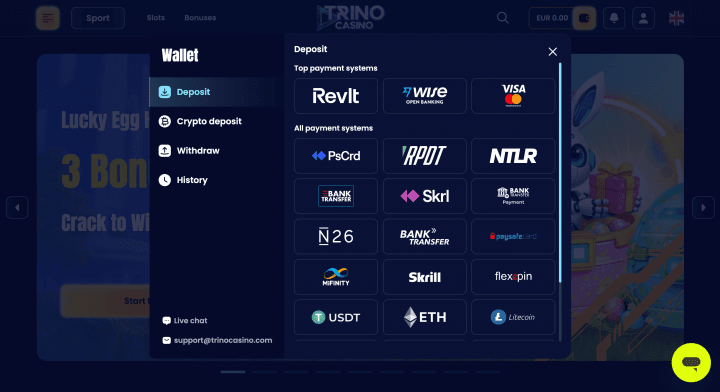
When I opened the deposit section, I observed a lineup that I would expect from a casino targeting the Danish market: Visa and Mastercard debit cards, Trustly for direct bank connections, Skrill, Neteller, MuchBetter, and in some cases a standard bank transfer. Each method has its own limit range, and while the exact numbers can shift with promotions or seasonal adjustments, I could pinpoint a typical floor for casual players. For card payments and most e-wallets the minimum deposit usually sits between 100 and 200 Danish kroner, a barrier low enough for anyone who simply wants to test the waters with a small balance. The upper limit per transaction, on the other hand, tends to be more conservative for cards, often capping at around 20,000 kroner, whereas some e-wallets might allow significantly larger sums in a single move. I always recommend checking the cashier in real time because limits displayed right before you type in an amount are the ones that count today, not the numbers posted in a generic help article.
For high rollers or those bankrolling a serious session, bank transfer usually acts as the vehicle with the highest ceiling. I noticed that direct bank-in options, particularly through Trustly, can support upper transaction limits that reach well into six figures in kroner, though the processing time stretches compared with instant e-wallet top-ups. The instant nature of most deposit methods means that the moment you click confirm, the funds appear in your playing account, regardless of whether you are at home on a computer or tapping the screen on a mobile phone. What I did not see during my research were any warnings about deposit rejections due to Danish kroner being an unsupported currency; the interface consistently switched to DKK when I simulated a local connection. That indicates the operator has built its payment flow with the Nordic customer in mind, not as an afterthought. Still, I encourage you to look at the cashier page before registering to see the current list of methods and their exact minimums, because an acquirer can occasionally remove a card option without notice.